

Review · TORONTO
Toronto Distillery District Walking Tour
Toronto’s Distillery District is more than a handsome collection of brick buildings. It is the former Gooderham & Worts complex, a place where grain, milling, and whiskey helped shape Toronto’s early growth. This tour explains how that working industrial site became one of the city’s most popular areas for shops, cafés, restaurants, and breweries.
I like the short one-hour format, which gives you useful history without taking over your afternoon. I also like the small maximum group of 15, since it gives the guide room to point out details you would likely miss while walking alone. The main consideration is that this is an outdoor walking tour, and the activity may be canceled in poor weather.
Key details before you book

- Victorian industrial buildings: See preserved architecture connected to Toronto’s milling and whiskey-making past.
- From grain to global whiskey: Learn how a modest milling operation developed into Gooderham & Worts, once one of the world’s largest distilleries.
- One-hour pace: The tour gives you a focused introduction, then leaves time to browse shops, cafés, and restaurants on your own.
- Guides with different strengths: Erik, Tom, David, Zach, Aaron, and others are praised for clear storytelling, humor, and local insight.
- Small-group setting: The group is capped at 15 people, making it easier to hear and ask questions.
- Afternoon scheduling: Two regular afternoon departures are offered, with other times possible by request if available.
Why the Distillery District deserves a guided walk
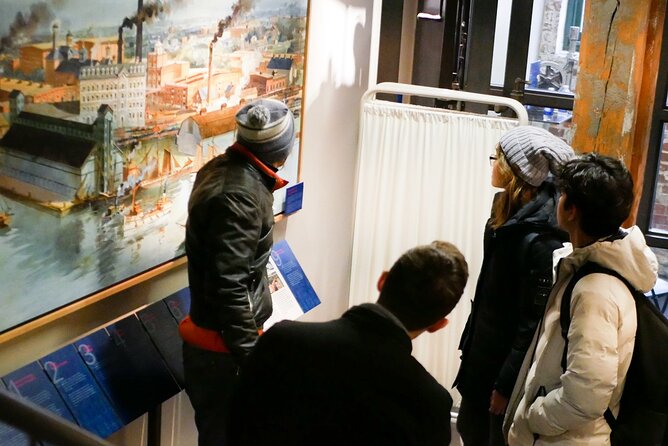
The District is easy to visit on your own, but it is not always easy to understand. You can admire the old brick walls, stone details, and industrial lanes without realizing what each building once did. A guide gives the place a working identity instead of leaving it as a photogenic shopping quarter.
The central story follows the rise of Gooderham & Worts. The area began with milling, then grew into a major whiskey operation. That shift links the buildings to Toronto’s growth, Canadian business, transportation, and the changing role of Lake Ontario.
One particularly useful detail concerns the shoreline. At the time of the original windmill, Lake Ontario reached much closer to the site than it does today. That fact helps you picture the district as an active industrial waterfront rather than an isolated cluster of historic buildings.
The tour also covers the site’s transformation into the modern Distillery District. You are not simply looking backward at an abandoned factory. You are seeing how old industrial buildings were given a new purpose while keeping much of their original character.
More Distillery Tours in Canada:
- Toronto: Distillery District Historic Walking Tour
★ 4.8 · 267 reviews - 30-Minute Distillery District Segway Tour
★ 5.0 · 214 reviews - Quebec City: Honey and Distillery Tour with Tasting
★ 4.9 · 103 reviews
Meeting at 11 Gristmill Lane
The tour begins at Go Tours Canada, at 11 Gristmill Lane. This is also where the walk ends, so you do not need to arrange a separate pickup or figure out where to reunite with your group.
Give yourself enough time to reach the meeting point. The tour runs in the afternoon, with two regular departure choices, and the operator may arrange another departure time if you request one and availability allows.
The ticket is mobile, which keeps things simple. Confirmation is provided when you book. Since the area has shops, cafés, restaurants, and breweries, I would plan to stay after the tour rather than rushing away when the hour ends.
Walking through Victorian industrial Toronto
The main portion takes place inside the Distillery Historic District. Expect a mix of outdoor stops and a few indoor stops as the guide explains the area from its foundation to its present-day use.
The architecture is the star at first glance. Victorian industrial buildings are not designed like grand civic landmarks. Their appeal comes from practical details: brick walls, old factory proportions, lanes built for work, and the sense that the site once had a clear commercial purpose.
A guide helps you read those details. Instead of simply seeing old buildings, you learn how the complex functioned and why the buildings were placed and used as they were. The tour is especially useful if you enjoy architecture but want more than a list of dates.
The route also brings in stories of business intrigue and the people behind the company. That human side keeps the walk from becoming a dry architectural survey. Guides such as Erik and Tom are praised for combining facts with humor, while David is noted for bringing the past to life in a way that helps you picture everyday life in the district’s working years.
From milling operation to whiskey producer
The strongest part of the tour is the industrial story. Gooderham & Worts did not begin as a grand whiskey empire. The company grew from a milling operation into a major producer, and the change tells you a great deal about Toronto’s commercial past.
The focus is not only on alcohol. Grain had to be processed, buildings had to support production, and goods had to move through the city. The guide uses the district to explain how a business developed over time and how one company became one of the world’s largest distilleries.
That wider context makes the tour useful even if whiskey is not your main interest. You get a look at how a city grows around work, industry, trade, and changing technology. You also see why preserving industrial buildings can tell a different story from preserving a church, government building, or wealthy home.
The historical details can be surprisingly specific. One guide’s presentation was described as moving from flour to alcohol, while another explained the site’s development from mill to brandy and whiskey production. Those details give the hour a clear thread and help the story hold together.
More Whisky Walking Tours in Canada:
- Toronto: Distillery District Breakfast Walking Tour
★ 5.0 · 10 reviews - Toronto: Distillery & Old Town Private Walking Tour
★ 4.3 · 7 reviews - Louisville: Private Guided Food, Bourbon & History Walking Tour
★ 5.0 · 45 reviews - Dublin 6 Whiskey Tasting & 3 Food Pairing Walking Tour with Local
★ 5.0 · 42 reviews
A modern district with old bones
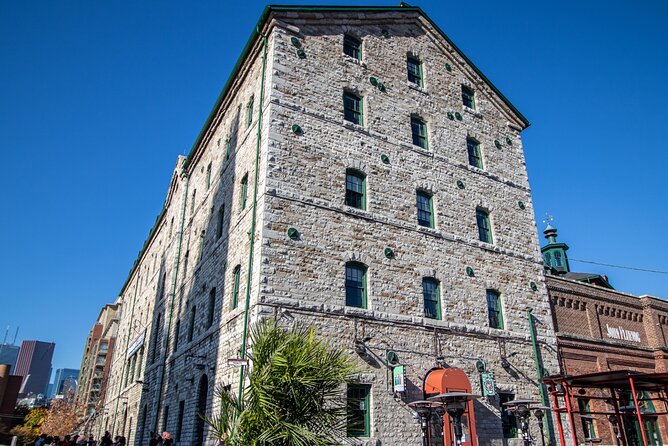
The tour does not pretend the area stopped in the nineteenth century. The old complex now contains shops, cafés, restaurants, and breweries, and the guide explains the change from industrial site to modern district.
I like that balance. You get the history first, then have time to enjoy the present-day area with better context. A shop or café feels different when you understand that the lane once served a working production complex.
The current district also gives the tour a little variety. You are not walking through a preserved site with nothing happening. You are moving through an active neighborhood that uses historic buildings for new purposes.
Still, this is not a full food tour, brewery tour, or tasting tour. One account mentions ending with a chocolate tasting, but that should not be treated as a guaranteed part of every departure. The main promise is history, architecture, and a guided walk.
The guides make the difference
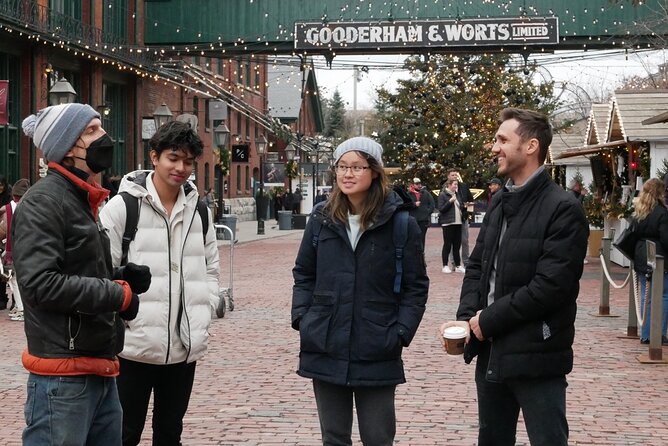
The operator uses several guides, and the names that appear most often include Erik, Tom, David, Zach, and Aaron. The most consistent strength is their ability to make history accessible rather than formal or stiff.
Erik is described as passionate, funny, and able to connect the district’s past with broader Canadian history. He also adjusted the route during a hot day by using shaded areas and cooler indoor spots when possible. That kind of practical judgment matters on a walking tour.
Tom is praised for enthusiasm and for making the tour fun while explaining the area clearly. Zach has also been singled out for helping a lifelong Toronto resident learn something new. David is noted for telling stories that make the district’s earlier years easier to picture.
A good guide can also adjust the tone for different ages. One family account describes an almost ten-year-old becoming involved through an activity and finding the history engaging. That does not mean every child will be equally interested, but the format can work for families when the guide keeps the stories moving.
The exact guide is not specified in advance in the information provided. You should book this for the subject and format rather than expecting one particular person.
The one-hour length: useful focus or too short?
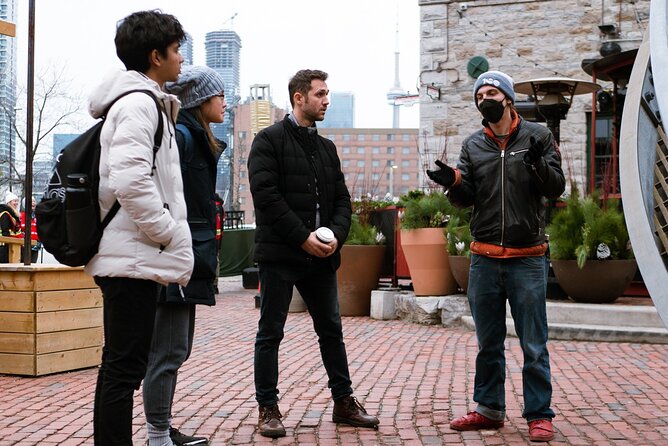
For most people, one hour is a sensible length. It gives you a clear introduction without exhausting you, and it fits easily before dinner, another Toronto sight, or independent time in the district.
I especially like this length for a first visit. You get the basic story, see the key areas, and finish with enough energy to explore on your own. The route also appears to move at an easy pace, with one account calling it a comfortable walk.
The tradeoff is depth. You will not cover every building or spend long periods inside. The tour makes a broad, focused circuit rather than offering a full study of Toronto’s industrial development.
If you are a serious architecture or whiskey enthusiast, you may wish the tour lasted longer. For a general visitor, the compact format is more likely to feel useful than rushed.
Group size, weather, and comfort
The maximum group size is 15 people. That is small enough to keep the guide within range and make questions practical, while still allowing the tour to operate as a shared experience.
Most people can participate, and service animals are allowed. The activity is near public transportation, which helps if you are visiting the district as part of a larger day in Toronto.
Weather deserves attention. The tour requires good weather, and poor conditions can lead to a cancellation with either a different date or a full refund. Even when the tour runs, much of the experience takes place outdoors, so dress for the forecast and be ready for changing conditions.
A hot day can make a walking tour less pleasant, though guides may use shade and indoor areas when possible. Winter can also change the feel of the visit. One tour went ahead during heavy snow, but another account suggested summer would be better. I would choose a mild afternoon when possible.
Is $21.22 a fair price?
At $21.22 per person, the value depends on how you use the hour. You are paying for a professional guide, local taxes, a small group, and a structured explanation of a district that is free to enter on your own.
If you only want photographs and a quick walk through the lanes, you can visit without paying. The ticket makes more sense if you want to understand the buildings, the whiskey company, the shoreline changes, and the district’s shift into a modern neighborhood.
The price is also reasonable for a compact guided introduction. You do not lose half a day, and the tour can help you decide where to spend the rest of your time. I would think of it as a history primer that improves your independent visit afterward.
The strongest value comes from the guides. Their storytelling, humor, and ability to connect local events with Toronto history are what turn the walk into more than a simple orientation.
Who should book this Toronto walk?
This tour suits you best if you enjoy:
- Historic buildings with a clear connection to business and industry
- Short guided walks rather than long museum visits
- Local stories about Toronto’s growth
- Whiskey history, even if you are not looking for a tasting
- Small groups and an easy afternoon schedule
- Time to explore shops, cafés, restaurants, and breweries afterward
It is also a good choice for families, couples, solo visitors, and Toronto residents who want a fresh look at a familiar area. The tour can work for children, but the subject is historical storytelling rather than a dedicated children’s activity.
You may want something else if you expect a long production tour, a guaranteed tasting, or extensive indoor access. The experience is primarily an outdoor walk through the historic district, with only a few indoor stops.
Practical booking advice
The experience is booked, on average, 26 days in advance, so I would reserve ahead if your Toronto dates are fixed. Confirmation arrives at booking, and you can use a mobile ticket.
Free cancellation is available up to 24 hours before the start time. Cancellations or changes made within 24 hours are not accepted for a refund. If poor weather causes the operator to cancel, you are offered another date or a full refund.
Because the tour returns to its starting point, it is easy to combine with independent time in the Distillery District. I would book an afternoon departure, take the tour first, then stay for food, browsing, or a drink. That order gives you the background before you explore the area on your own.
Should you book it?
I would book this tour if you want the Distillery District to make sense, not just look attractive. The strongest parts are the Victorian industrial setting, the story of Gooderham & Worts, and guides such as Erik, Tom, David, and Zach who bring energy and humor to the history.
At one hour and $21.22, it is a practical introduction with little time risk. Just remember that weather can affect the schedule, the tour is mainly outdoors, and it is not designed as a full distillery production visit or guaranteed tasting.
Book it as the beginning of your time in the district. The tour gives you the background, then the old lanes, shops, cafés, restaurants, and breweries give you reasons to stay.
FAQ
How long is the Toronto Distillery District Walking Tour?
The tour lasts approximately one hour.
Where does the tour start?
It starts at Go Tours Canada, 11 Gristmill Lane, Toronto, Ontario, M5A 4R2.
Where does the tour end?
The activity ends back at the meeting point at Go Tours Canada.
How many people can join the tour?
The group has a maximum of 15 participants.
Is the tour offered in English?
Yes. The tour is offered in English.
What is included in the price?
The price includes a professional guide and local taxes. The listed price is $21.22 per person.
What happens if the weather is poor?
The activity requires good weather. If the operator cancels because of poor weather, you can choose a different date or receive a full refund. You can also cancel for a full refund up to 24 hours before the start time.
Fresh on the whisky trail around Canada
- Victoria Craft Beer and Distillery Tour★ 5.0 · 5 reviews
- Distillery District Breakfast Tour★ 5.0 · 21 reviews
- Toronto Distillery District: Whisky Exploration Game and Tour★ 3.5 · 4 reviews
- Full-Day Wine, Whiskey & Beer Tour w/ Lunch Pairing★ 5.0 · 2 reviews
- Brewery & Distillery Tour (Craft Beer, Spirits, and Cocktails)★ 5.0 · 21 reviews
- Park Distillery Tour with Craft Spirits Tasting★ 5.0 · 23 reviews
- Toronto: Distillery District Breakfast Walking Tour★ 5.0 · 10 reviews
- Toronto: Nickel 9 Distillery Tour and Tasting★ 5.0 · 2 reviews
Whisky Walking Tours, side by side.

Toronto: Distillery District Historic Walking Tour
Read our review →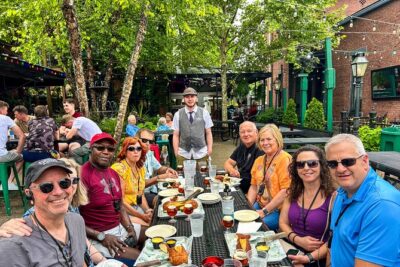
Louisville: Private Guided Food, Bourbon & History Walking Tour
Read our review →
Dublin 6 Whiskey Tasting & 3 Food Pairing Walking Tour with Local
Read our review →
A Wee Walk and a Whisky: Unique Glasgow Walking Tour (5pm)
Read our review →
Explore Glasgow: Scottish Rogue Whisky Walking Pub Crawl
Read our review →
Edinburgh: Harry Potter Walking Tour and Whisky Tasting
Read our review →
Whisky Bars & Gin Joints: Melbourne Walking Tour
Read our review →Lists this tour appears on